 Maisie Bee
Search has changed more in the past three years than it did in the preceding decade. The rise of AI search, hyperlocal intent, multimodal queries and stronger technical demands are reshaping SEO for 2026.
We want to share with you everything you need to know about SEO today, what has changed and what will continue to evolve. If you want your website to thrive in an ever-changing search environment that is increasingly AI-driven, experience-focused and technically demanding, this is your starting point.
What Has Changed in SEO Over the Last Few Years?
Search behaviour has shifted dramatically. Not only are users searching differently, but search engines themselves now understand and interpret content on a deeper level.
- AI-assisted search is now normal
Tools such as ChatGPT, Perplexity, Gemini and Claude are influencing buying decisions before users ever reach Google. People are asking conversational questions instead of typing short keywords, and they expect direct answers rather than lists of links.
Industry data shows a 357% year-on-year increase in AI referral traffic globally (June 2024–2025), with ChatGPT accounting for nearly 80% of those visits.
- User intent is clearer and more specific
Search engines have become better at identifying what users actually want. Content now needs to match the problem being solved, not just the words being typed.
- Technical SEO is now non-negotiable
Fast sites, clean structures and reliable schema markup influence how well content is understood by AI systems and traditional engines alike. Good technical foundations directly affect visibility.
Technical SEO is the foundation of your house. You can decorate it beautifully with great content, but if the wiring is faulty, the doors stick and the roof leaks, no one is going to stay inside. A fast, clean, well-structured site is what helps both humans and AI navigate your content without getting lost.
- Content quality expectations have increased
Search engines and AI platforms reward authoritative, structured and clearly written content. Thin articles and keyword stuffing no longer work. Brands must demonstrate expertise and offer real value.
Brands must demonstrate E-E-A-T (Experience, Expertise, Authoritativeness and Trustworthiness). They need to show real-world experience, transparent sourcing and clear author credentials. Content written by someone who has used the product or lived the experience is now often prioritised over a compilation of facts.
However, to provide stronger E-E-A-T signals to AI systems, it’s not enough to simply write expert content. You must use Author and Organisation Schema Markup to create a verifiable digital identity. This technical linking of the author’s credentials, brand and content allows AI models to trust the source material absolutely
Will SEO Still be Relevant in 2026?
With all the changes in technology, some people this year have wondered if SEO would become less important. The opposite has happened. SEO has expanded to cover more platforms and more search contexts. Visibility is now multi-layered and businesses need to appear wherever users are asking questions.
This means SEO is no longer just a marketing channel. It is now a visibility strategy.
How has AI Changed Search?
AI has influenced every part of search, from how content is indexed to how answers are delivered. Understanding this helps brands decide how to structure content and how to position themselves.
The brands that appear consistently in AI answers are ones that publish detailed, expert-led content backed by a clear technical structure.
The rise in branded searches supports the pattern of Zero-Click Discovery. Users find the answer and the citing brand in the AI interface. Then they search for the brand directly for final validation and conversion.
How do AI Platforms Decide What Content to Show?
AI assistants look for:
- Clear, structured information
- Factual, reliable explanations
- Content written by specialists or brands with authority
- Step-by-step guides that answer a full problem
- Educational tones
They pull from websites, articles, videos, forums and other sources. They do not treat every source the same. Websites with strong technical health, clear expertise and well-structured content are favoured.
AI share-of-voice is now measurable: how often a brand is cited in ChatGPT, Perplexity and AI Overviews. AI Overviews are on the rise, with 13.14% of all queries triggering AI Overviews in March 2025. That figure is up from 6.49% in January 2025. This metric is emerging as a competitive advantage as AI assistants increasingly recommend products and services directly.
Do Keywords Still Matter?
Yes, but not in the way they used to. AI tools look for themes, topics and relationships between ideas. This means brands must cover subjects comprehensively rather than relying on individual keywords. Topic clusters, pillar pages and connected content matter more than exact search phrases.
What Role Does Content Play in AI Search?
Content is still the foundation of discoverability. AI platforms summarise information in their own way, but they rely on strong source material. The better the original content, the more likely it is to be used as a reference.
This is why many brands are returning to high-quality writing, expert-led articles and deeper insights. Surface-level content is no longer enough.
Profound’s analysis of 50 million ChatGPT prompts shows that although only 9.5% of prompts appear “commercial”, most informational prompts still influence purchase decisions. This is demonstrating how AI search shapes buying journeys long before users reach Google.
Does Technical SEO Still Matter in 2026?
Yes. It is more important now because AI systems analyse websites differently. Technical SEO ensures that content can be interpreted correctly and that search features display information as intended.
Which Technical Website Factors Matter Most Today?
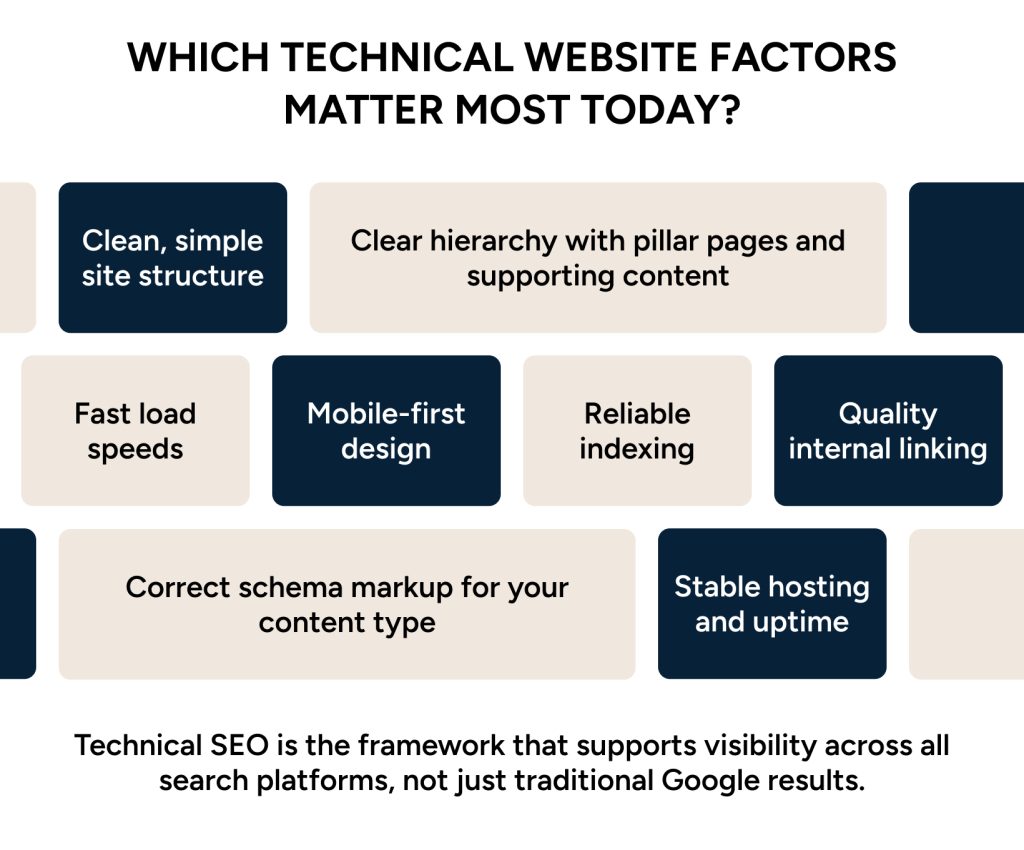
- Clean, simple site structure
- Clear hierarchy with pillar pages and supporting content
- Fast load speeds
- Mobile-first design
- Reliable indexing
- Correct schema markup for your content type
- Quality internal linking
- Stable hosting and uptime
Technical SEO is the framework that supports visibility across all search platforms, not just traditional Google results.
Why is Technical SEO Non-Negotiable for AI Search in 2026?
AI models read sites like humans do. They look for clarity and structure. A well-organised site makes it easier for AI to extract accurate information. Poor structure leads to your content being ignored or misinterpreted.
AI agents (automated decision-makers) are emerging as new “buyers”. Already, 24% of consumers and 32% of Gen Z say they are comfortable with AI making purchases for them. These agents rely heavily on structured data, schema and technically sound sites.
Curious whether your website’s technical foundation meets 2026 standards? Book a technical SEO audit with the team today.
The Technical SEO Analogy (The AI Librarian)
Think of your website as a massive, high-value research library. In the past, traditional search engines only needed the main title to understand your relevance.
Today, AI systems (like Gemini and ChatGPT) are acting as hyper-efficient, demanding research librarians. Those librarians must instantly catalogue, verify and extract specific facts from your content:
- Content and E-E-A-T are the expert-written books on the shelf.
- Technical SEO is the library’s complete, modern infrastructure: the flawless digital catalogue (Schema Markup), the organised shelving system (Site Structure) and the fireproof security (Load Speed/Uptime).
If your technical SEO is messy, the catalogue is broken, and the books are unindexed, the AI librarian cannot find, trust, or verify your information efficiently. It will skip your library entirely, opting to cite a less comprehensive source that is better organised. Technical SEO is the key to verifiable authority.
Is Site Speed Important for SEO?
The emphasis on site speed and technical integrity is not merely about user experience; it’s about machine interpretation. Our team has observed a clear correlation between page performance and AI citation frequency.
Mia Clarke, Pod Digital’s Creative Director, emphasizes that slow load times are now an immediate visibility killer, not just an inconvenience.
“The modern AI crawler doesn’t have the patience of a human. If a site’s infrastructure is slow, complex, or poorly coded, the AI assumes the data is low quality and moves on instantly. A perfectly optimised site, particularly for Core Web Vitals, is the price of entry for appearing in today’s most valuable search real estate.”
Where is SEO Heading Over the Next Few Years?
Search will continue to evolve toward a more conversational, personalised and multi-platform experience. SEO will always adapt, but its core principles will remain the same: technical clarity, helpful content and trustworthy expertise.
What can we Expect From Search by 2027?
- More blended results combining text, video, images and AI explanations
- Greater emphasis on accuracy and authority
- More personalised results depending on user behaviour
- Increased importance of structured content
- Growing visibility across non-Google platforms
Brands that invest in high-quality content and strong technical foundations will continue to benefit, no matter how search evolves.
We are already seeing instability in Google’s AI Overviews. Finance-related visibility dropped by up to 53% between April and September 2025. This volatility is likely driven by the rollout of Google’s Gemini-powered AI Mode, which is being positioned as the future default search experience.
How to Build a Future-Proof SEO Strategy for 2026: The 3-Point Checklist
Succeeding with SEO in 2026 requires shifting your focus from keywords and ranking positions to building authoritative digital assets that feed AI discovery. The landscape is richer and more dynamic, but success relies on these three core areas:
- Prioritise Generative Engine Optimisation (GEO): Structure content to answer conversational queries directly, maximising AI share-of-voice.
- Authenticate E-E-A-T: Prove your expertise through clear author credentials, case studies and unique, experience-based insights.
- Perfect the Technical Foundation: Ensure pristine schema markup, fast loading speeds and a clear site hierarchy to enable accurate AI analysis.
Keeping Ahead of the Game with Pod Digital
We understand that these changes can feel sudden for many businesses. However, at Pod Digital, our preparation for the AI shift began nearly three years ago with the early testing of Google’s Search Generative Experience (SGE) in the US market.
Recognising that AI was compressing the user journey from click-through to citation, we immediately began evolving our strategies. We looked from traditional SEO (ranking) to Generative Engine Optimisation (GEO) (citation and brand influence).
This early adoption allowed us to develop and refine the precise technical, content and E-E-A-T structures necessary. We earned placements in AI Overviews before they became the default search experience.
Case Study: Instant AI Overview Visibility
When Google’s AI Overviews rolled out in the UK, our client, a large home improvement retailer, gained instantaneous visibility. This was not luck; it was the direct result of a proactive Generative Engine Optimisation (GEO) strategy implemented in the preceding 12 months.
Recognising the threat of Zero-Click Discovery, we treated their website as an information source for AI, not just a link destination. Our preparation focused solely on two things: technical SEO with Schema Markup and genuinely helpful content written in a way AI could discover.
This early focus allowed the client to become part of AI’s knowledge graph and be the informational source. It proved that preparing for the AI future delivers immediate, measurable competitive advantage.
Ready to Take the Lead in AI Search?
SEO is changing fast, and brands that adapt early gain the advantage.
If you want to appear in AI search results, AI Overviews and traditional Google rankings, our SEO services can help you build a strategy that keeps you visible in 2026 and beyond.
Whether you want to:
- Appear prominently in AI Overviews and ChatGPT answers,
- Strengthen your technical SEO framework, or
- Redefine your content strategy for E-E-A-T and GEO,
Our experts can help you future-proof your digital presence. Schedule your free strategy consultation today, and discover how to stay visible in AI search, Google results and beyond.