 Jane Wardle
In the first few weeks of 2026, AI platforms have crossed a tipping point. Google and OpenAI have both rolled out changes that fundamentally alter how people discover brands, evaluate options and make purchases online.
From deeply personalised AI recommendations, to in-AI checkout, to advertising embedded directly inside AI answers, search is no longer just about visibility. It is becoming the interface where decisions happen.
The most significant developments include:
- Gemini Personal Intelligence
- Universal Commerce Protocol (UCP)
- The commercialisation of AI platforms, including ads in ChatGPT
Here’s what’s changed, why it matters to you and what businesses need to do next.
Gemini Personalisation: “Personal Intelligence”
Google’s Gemini has launched Personal Intelligence as a beta in the U.S. It is designed to make AI responses more personal, proactive and useful.
Personal Intelligence connects services such as Gmail, YouTube, Google Search, Photos, and Maps directly to Gemini. This allows the AI to shape answers, and take actions, based on what it already knows about how someone lives, works and buys.
To make this tangible, here’s how that personalisation might work in practice.
If you ask:
“Where should I stay for a weekend in Edinburgh?”
Gemini may already know that you:
- Tend to book boutique hotels rather than large chains
- Watch YouTube videos about food-led city breaks
- Save restaurants and bars in specific neighbourhoods on Google Maps
- Have booked similar trips before via Gmail confirmations
Instead of showing a generic list of hotels, Gemini could prioritise:
- Independent hotels in neighbourhoods you’ve previously enjoyed
- Locations near places similar to those you’ve visited before
- Options that align with your usual budget and travel habits
Or if you ask:
“Do I need a new laptop?”
Gemini could factor in:
- When your current laptop was purchased, based on past email receipts
- Recent searches for software that requires more processing power
- Laptop reviews or comparison videos you’ve watched on YouTube
- How and where you typically work, inferred from location patterns
Rather than offering generic advice, the response could move quickly towards:
- Recommending upgrade options suited to how you actually use your device
- Suggesting brands you’ve bought from before
- Highlighting retailers you already trust
Surfacing relevant availability or offers.
How AI Platforms Decide Which Brands to Recommend
This is where the real shift happens.
Personal Intelligence changes how recommendations are formed. Two people asking the same question may receive entirely different answers. Their answers aren’t based on keywords, but on their past behaviour, buying habits and brand preferences.
Over time, this reinforces familiarity. Brands a user has interacted with before are more likely to be recommended again. Unknown brands face a higher barrier to entry, even if their product is objectively competitive.
For businesses, this means:
- Existing customer relationships matter more than ever
- Brand preference increasingly influences AI recommendations
- Retention and loyalty directly affect future visibility
This also reshapes the competitive landscape. AI platforms are no longer neutral answer engines serving the same results to everyone. They are personalised decision systems, shaped by long-term user behaviour and historical signals.
The implication is clear: visibility in AI Search is no longer just about being the best answer. It’s about being the most familiar and trusted option for the individual asking the question.
Universal Commerce Protocol (UCP): Buying Without a Website Visit
Google has announced Universal Commerce Protocol (UCP) as a beta in the U.S. It is designed for a future where AI doesn’t just help people research products, but actually completes purchases for them.
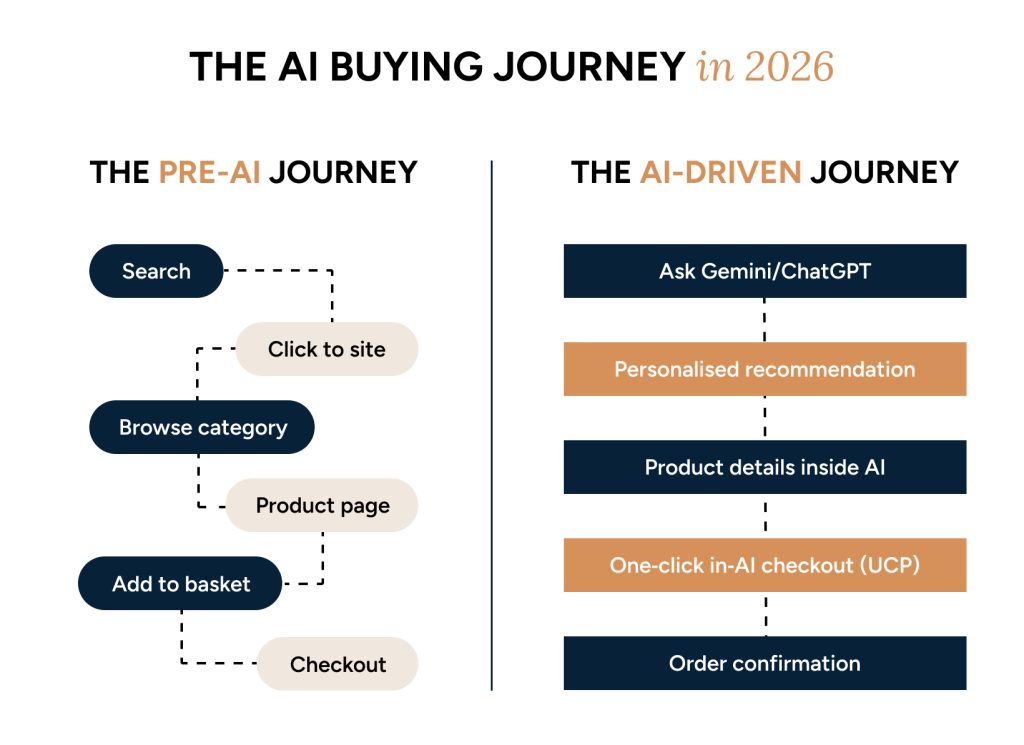
In simple terms, UCP allows someone to find a product, decide to buy it and check out without ever leaving Google’s AI experience, such as Gemini or AI Mode.
Instead of clicking through to a retailer’s website, adding items to a basket and going through checkout, the entire process can happen inside the AI interface. Payment is handled using saved details like Google Pay. The retailer still fulfils the order as normal, but the website is no longer part of the journey.
This is a major shift. AI is no longer just influencing decisions. It’s actively making them happen.
What This Looks Like in Real Life
Imagine someone asks:
“What’s a good desk chair for working from home?”
Instead of:
- Seeing a list of blue links
- Visiting several retailer websites
- Comparing products manually
Gemini could:
- Recommend a specific chair
- Explain why it suits that person’s needs
- Show the price and delivery details
- Allow the user to buy it instantly
All without the user ever visiting the retailer’s site.
Or consider:
“I need a last-minute gift under £50.”
The AI could:
- Surface suitable products
- Apply filters automatically
- Highlight availability and delivery dates
- Complete the purchase in a single step
From the user’s point of view, it feels faster and easier. From the business’s point of view, the decision and the sale now happen upstream, inside the AI layer.
Supporting Changes Rolling Out With UCP
To support this shift, Google is also introducing:
- Branded AI agents
AI agents allow customers to “chat” directly with a retailer inside Gemini, asking questions about products, delivery or returns, without going to the website. - New ad formats inside AI conversations
Instead of traditional search ads, offers and promotions can appear naturally within AI answers when someone is ready to buy.
New Merchant Centre data designed for AI
Product data is no longer just about keywords. It’s about helping AI understand what a product is, who it’s for, and when it should be recommended.
How AI Platforms Decide Which Products Get Bought
For eCommerce businesses, this is a platform-level change, not a small feature update.
If your product is recommended inside Gemini:
- The buying journey is shorter
- There are fewer steps for customers to drop off
- Conversion rates may improve
If your product is not recommended:
- You’re not just ranking lower
- You may be completely excluded from the buying journey
In other words, visibility now determines whether you’re considered at all.
What Actually Drives Performance Now
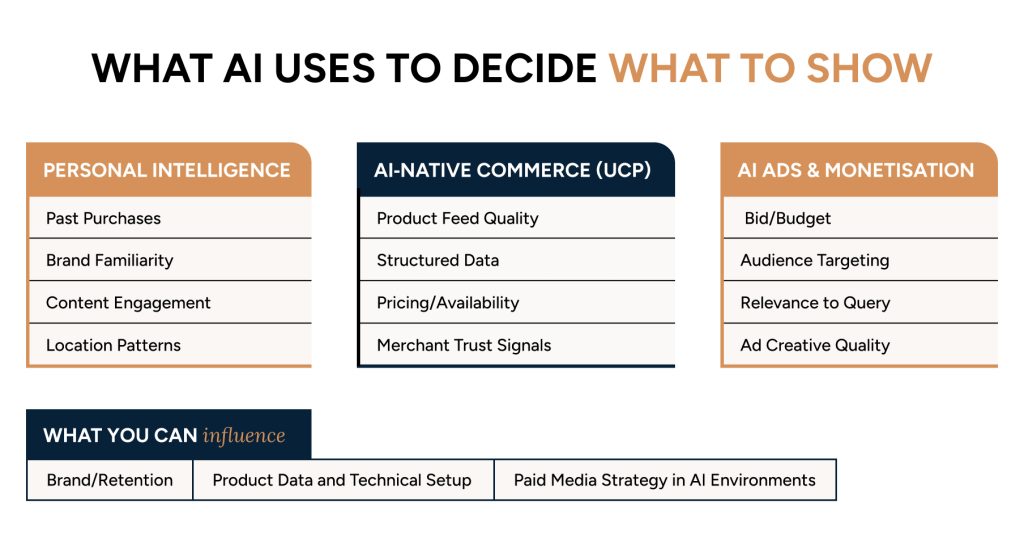
As buying moves into AI conversations, the things that drive performance change too:
- Product feeds and structured data become critical
AI relies on clean, accurate product information to decide what to show. - Paid placements move into AI conversations
Ads are no longer confined to search results pages. They appear at the moment of decision. - Product descriptions and categorisation matter more than ever
How clearly your products are described influences whether AI understands and recommends them.
AI Mode is a testing ground for this future. Features that appear here first are likely to shape how search and shopping work more broadly over time.
For businesses, the takeaway is simple but uncomfortable:
If AI can’t understand your products well enough to recommend them, you won’t get the sale, even if demand exists.
ChatGPT Introducing Ads: The Commercialisation of AI Search
Alongside Google’s updates, another important shift is happening across the AI landscape: ChatGPT is beginning to introduce advertising into the platform.
Ads are expected to appear initially for free and lower-cost users, clearly labelled and separated from organic AI responses. Paid tiers will remain ad-free.
This development echoes the shift from largely organic Google results to ad‑led SERPs in the early 2010s, where commercial models gradually reshaped what users saw first.
While OpenAI has stated that ads will not directly influence model answers, their presence marks a significant change in how AI platforms are monetised.
This matters because it confirms something important:
AI search is becoming a commercial environment, not just an informational one.
As AI tools evolved from assistants into discovery and decision-making platforms, monetisation was inevitable. Advertising introduces new dynamics:
- Visibility inside AI tools can be influenced by paid placement
- Commercial intent becomes easier for platforms to monetise
- Trust, transparency and labelling become critical factors
For marketers, this signals a familiar pattern. Just as traditional search evolved from organic results to ad-heavy SERPs, AI platforms are following a similar path. However, it will have far fewer visible boundaries between answers, recommendations and promotions.
The implication is clear: brands need to understand how AI platforms balance organic recommendations, commercial placements and personalisation. All three will shape what users see.
What All This Means for Your Marketing Strategy in 2026
Taken together, these changes point to a clear direction of travel.
- Personalised AI decides what to recommend
- AI-native commerce turns recommendations into purchases
- Advertising moves directly into AI answers and conversations
AI Search is becoming the interface where discovery, evaluation and decisions happen.
This means marketing strategies can no longer focus solely on driving traffic. The priority is becoming the brand AI platforms choose to recommend, cite or surface at the moment of intent.
In practical terms, this means your digital marketing strategy must:
- Build brand authority and trust, as AI systems favour credible, recognisable brands
- Structure content, products and services so AI systems can interpret and compare them
- Invest in retention, because past behaviour shapes future recommendations
- Treat AI platforms as distribution channels where content, offers and ads appear directly inside answers
That is what AI Search Optimisation looks like in practice.
What This Means for Your Website in 2026
Your website is no longer the only destination, but it remains foundational for visibility and trust.
Here’s what businesses should focus on:
1. Your website still feeds AI platforms with reliable signals
AI systems continue to crawl and reference website content to understand what your business does, how credible it is and when it should be recommended. Clear, well-structured pages make it easier for AI platforms to interpret and use your information.
2. Content quality and structure now drive AI visibility
AI platforms prioritise content they can easily summarise, compare and justify. Clear headings, focused sections and well-written explanations make your site more usable for AI. This is important even when users never click through.
3. Technical SEO still underpins discoverability
Core SEO technical elements such as crawlability, site speed, accessibility and structured data help AI systems assess whether your content is trustworthy and up to date. These fundamentals still matter, but they now support AI understanding as much as rankings.
4. Your website builds credibility and trust
AI systems look for signals of expertise, authority and reliability. Case studies, reviews, clear service pages, transparent pricing or processes and up-to-date content all help AI decide whether your brand is safe to recommend.
Strong, consistent branding, including clear positioning, tone of voice and recognisable messaging, increases the likelihood that AI platforms surface your business again for the same user over time.
5. Websites remain the anchor for measurement and validation
Even as discovery and decisions move into AI platforms, your website remains the reference point for:
- On-site conversions that still occur
- Deeper brand and service explanations
- Cross-channel measurement and attribution
In short:
AI may change where discovery and decisions happen. However, your website remains the foundation that AI platforms rely on to understand, trust and recommend your business. Strong structure, clear content and technical health keep you visible, even when traffic is no longer guaranteed.
Win Visibility in AI Search With the Right Strategy
AI is no longer just influencing search. It is becoming the interface itself.
SEO, content marketing and digital PR still matter. What has changed is what they are optimised for. The goal is no longer just rankings. It is being selected, cited and recommended inside AI-driven experiences.
If your team needs clarity on how to win visibility in AI Search, our AI SEO agency can audit and optimise your presence across Gemini, ChatGPT and other AI‑driven ecosystems. Get in touch with us for the next stage of your AI search and digital marketing strategy.
FAQs
Will businesses still get website traffic if purchases happen inside AI platforms?
No, not always. AI-led recommendations and in-AI checkout allow customers to discover, decide and buy without ever visiting a website. Traffic still matters, but it is no longer guaranteed. If AI completes the journey, your site may never be part of the decision.
What happens if my products or services aren’t recommended by AI?
You may be completely excluded from the buying or enquiry journey if you’re not recommended by AI.
If AI platforms don’t understand or trust your products, services or brand, they won’t surface you at all. In AI-led search, not being recommended often means not being considered.
How do ads in ChatGPT and AI platforms affect search?
Ads in ChatGPT and other AI platforms turn AI search into a commercial environment, not a neutral one.
As ads appear inside AI answers, visibility is shaped by a mix of personalisation, organic recommendations and paid placements. AI Search Optimisation and paid media now work together, not separately.
What is Google’s Universal Commerce Protocol (UCP)?
UCP allows customers to buy products directly inside Google’s AI without visiting a website.
With UCP, discovery, decision and checkout can all happen inside Gemini or AI Mode. If your product is recommended, you can win the sale instantly. If it isn’t, you may never enter the journey.
What is Gemini Personal Intelligence?
Gemini Personal Intelligence personalises AI answers using a user’s real behaviour across Google’s platforms.
Gemini uses data from Search, Gmail, YouTube, Maps and more to tailor recommendations. Over time, this favours brands users already know, trust and buy from.
Are these changes more important for eCommerce or lead generation businesses?
Both eCommerce and lead generation businesses are affected, but in different ways.
eCommerce businesses face immediate impact from in-AI purchasing. Lead generation businesses must focus on being cited and recommended in AI answers. Ignoring either reduces future visibility.