If you’re planning to grow your business through your website in 2026, having strong SEO foundations in place is essential. Around 94% of all webpages receive no traffic from Google. Don’t let your website sit within that statistic.
At Pod Digital, we strongly recommend starting with a comprehensive SEO audit to identify the issues currently limiting your website’s performance and commercial growth online.
Understanding why an SEO audit is important comes down to one simple principle: you can’t improve what you haven’t properly diagnosed. An audit uncovers what’s holding your website back, highlights missed opportunities and pinpoints the areas that will deliver the greatest commercial impact when addressed.
What Is an SEO Audit?
An SEO audit is a full health check of your website’s ability to rank, convert and scale through organic search.
A proper audit reviews:
- Technical foundations and crawlability
- Content quality and keyword alignment
- Site structure, internal linking and authority flow
- Trust signals, backlinks and credibility
- Conversion performance and user experience
At Pod Digital, every SEO audit is designed to answer one key question:
What needs to change for this website to generate more revenue from organic search?
Why an SEO Audit Is Important for Long-Term Growth
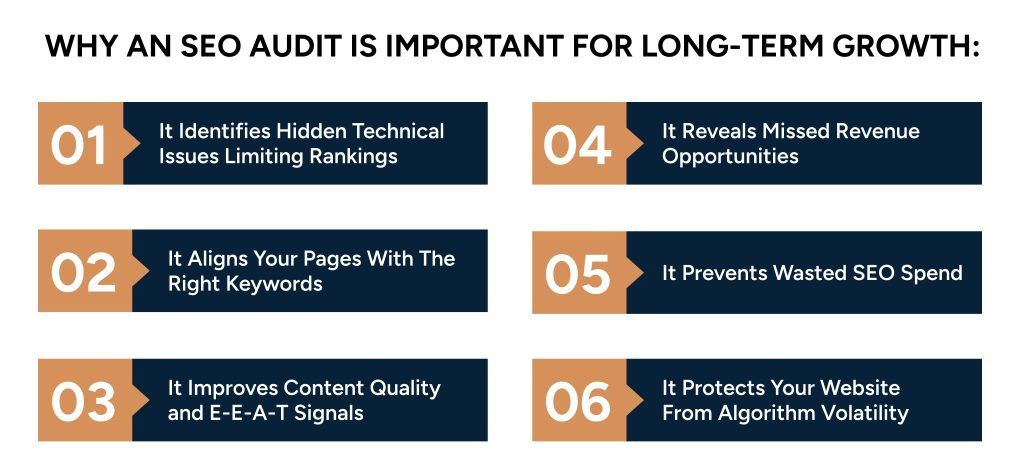
1. It Identifies Hidden Technical Issues Limiting Rankings
Your website may look fine on the surface, but it still struggles to rank due to underlying technical issues. This could be poor crawlability or indexing, slow page speed, JavaScript rendering problems, duplicate or thin pages and broken internal links.
Search engines rely on clean, efficient infrastructure. Even strong content can underperform if technical foundations are weak. An SEO audit exposes these issues immediately.
2. It Aligns Your Pages With the Right Keywords
One of the most common reasons businesses plateau in SEO is poor keyword-to-page alignment.
This often includes multiple pages competing for the same keyword, high-intent search terms buried in blog content or service pages optimised too broadly. An SEO audit maps one clear primary keyword focus per page, supported by relevant secondary terms, giving search engines and users clarity on what each page is designed to rank for.
3. It Improves Content Quality and E-E-A-T Signals
Google doesn’t just rank pages, it evaluates credibility.
An SEO audit reviews the depth and usefulness of content. It reviews how experience and expertise are demonstrated and whether trust signals such as reviews, case studies and credentials are clearly communicated.
Improving E-E-A-T (Experience, Expertise, Authoritativeness and Trust) is now even more essential, particularly in competitive industries and AI-driven search environments.
An audit highlights where content needs strengthening, not rewriting for the sake of it, but enhancing authority where it matters most.
4. It Reveals Missed Revenue Opportunities
SEO isn’t about volume alone, particularly when traffic lacks intent. It’s about attracting the right users, i.e. those ready to engage, enquire and convert.
A strong SEO audit uncovers high-value keywords you should already be ranking for. It finds pages that attract traffic but underperform on conversions, opportunities for new service or location pages and internal linking gaps that limit authority flow.
These insights allow SEO to directly support business growth, not just visibility.
5. It Prevents Wasted SEO Spend
Many businesses invest in content, links or technical fixes without a clear sense of priority.
An SEO audit helps prevent writing content for keywords you can’t realistically compete for and fixing low-impact technical issues first. It also focuses on building links to misaligned pages or optimising pages that don’t convert. Instead, effort and budget are focused on where they will deliver the greatest return.
6. It Protects Your Website From Algorithm Volatility
Search algorithms evolve constantly, and websites without strong foundations are the most exposed.
An SEO audit ensures your website follows current best practices, avoids outdated or risky tactics and is structured clearly for both search engines and users. This creates a more resilient platform that can adapt to future updates, particularly important for businesses reliant on organic leads.
How Often Should You Run an SEO Audit?
At Pod Digital, we recommend running a thorough SEO audit once or twice a year. Once issues have been identified and addressed, more frequent issue crawls should take place. This is to ensure fixes have been implemented correctly and no new problems have been introduced.
SEO audits should also be carried out immediately after major website changes, such as site migrations, to ensure performance is protected and no critical issues have been introduced.
What a Proper SEO Audit Should Deliver
A high-quality SEO audit should provide clear, understandable findings and prioritised actions.
Just as importantly, it should be backed by an experienced SEO team who can implement those recommendations correctly, resolving issues at their root cause.
Why Businesses Choose Pod Digital for SEO Audits
At Pod Digital, we approach SEO audits with one clear focus: helping your business grow, not simply ticking technical boxes.
Rather than handing over a list of issues, we take the time to explain what’s happening, what matters most and why. We’ll show you where to focus first, how resolving key problems can improve visibility and enquiries and what meaningful SEO success should look like for your business moving forward.
Every audit we deliver is tailored, data-led and aligned with your commercial goals. It is supported by a team that’s there to implement improvements properly, not just point them out.
A Joined-Up Marketing Approach to Fixing SEO Issues
SEO audits often uncover issues that go beyond keywords and content, from technical website limitations to user experience, design and messaging. That’s why our audits don’t stop at recommendations.
At Pod Digital, our SEO department sits within a fully joined-up marketing team. If an audit highlights the need for website improvements, our in-house web team can help to implement changes correctly. If clearer messaging, stronger brand positioning or video content is needed to improve engagement and trust, our creative and video teams are on hand to support.
This integrated approach ensures that fixes are applied properly and with performance in mind, without the delays or disconnect that often come from working across multiple agencies.
Ready to Get More From Your SEO?
If you want SEO to generate genuine commercial returns, you need to understand what’s holding your website back. A proper SEO audit gives you clarity on where improvements are needed, what to prioritise first and how to move forward with confidence.
Speak to Pod Digital to arrange a comprehensive SEO audit and put a clear, structured plan in place to drive sustainable organic growth.
Frequently Asked Questions:
Do I need an SEO audit if I’m already investing in SEO?
Yes. An audit ensures your current SEO activity is focused in the right places. It highlights whether effort is being spent on pages, keywords or fixes that won’t deliver meaningful returns, helping you prioritise what actually moves performance forward.
Can an SEO audit help explain why leads have slowed?
Absolutely. An audit can uncover issues such as misaligned keywords, weakened internal linking, technical barriers or conversion friction that impact enquiries, even when traffic levels appear stable.
Is an SEO audit a one-off or an ongoing requirement?
A full audit is typically a periodic exercise, but it should inform ongoing optimisation. Once we have resolved key issues, monitoring and targeted checks help ensure performance remains stable as your site and search algorithms evolve.
Can an SEO audit support website redesigns or migrations?
Definitely. Running an audit before and after major website changes helps protect rankings, prevent traffic loss and ensure new structures support long-term growth rather than introducing avoidable issues.
Is an SEO audit useful for established websites?
Very much so. Older websites often carry legacy issues, outdated structures or content that no longer aligns with how people search. An audit helps modernise performance without starting from scratch.