 Jane Wardle
TL;DR: AI search engines now answer most queries directly without clicks. It rewards content that’s structured for extraction, demonstrates clear expertise and answers specific questions in natural language. To stay visible in 2026, shift from:
- Keyword-focused content to topic authority.
- Long-form obscurity to answer-first formatting.
- Basic content to entity/schema optimisation that helps AI systems find, trust and cite your brand.
Head of SEO, Maisie Bee says, “The SEO and Content game has fundamentally changed. Our focus is no longer on simply chasing keywords, but on becoming the definitive, trusted entity in your space. In the Age of AI Search, content must be structured to be easily extracted and answer specific problem statements immediately.
If an AI assistant can’t find trust and quote your answer, you don’t exist in the modern search journey. Content structure is the new link building.”
NAVIGATE THIS ARTICLE:
- How AI Search Has Changed Content Marketing
- Why Optimising for AI Search Matters Now
- Why Content Marketing Has Changed Again
- Why is Content Important for SEO in 2026?
- How do you Demonstrate E-E-A-T in an AI Search World
- What is the 2026 Content Marketing Strategy Framework
- What are the Technical Foundations for AI-Ready Content
- How do you Measure Performance in an AI Search World
- Is Content Still the Heart of Digital Marketing
- Let’s Build Your AI-Ready Content Strategy
- FAQs
How AI Search Has Changed Content Marketing
AI Search has reshaped how people discover, evaluate and engage with brands. Google’s AI Mode, generative summaries and conversational search have changed the rules for SEO and content marketing.
Traditional SEO treated Google like a library index. AI Search treats it like a researcher who reads everything for you and hands over a summary.
To stay visible, your business needs a content marketing strategy built for an AI-first world.
It’s also important to recognise that on-page optimisation is only one piece of the puzzle. Your wider digital footprint, how often you’re cited, where you’re mentioned, the sentiment around those mentions, and how clearly your brand is understood as an entity is vital. It increasingly shapes how AI systems evaluate and surface your content.
Why Optimising for AI Search Matters Now
Recent industry data suggests that visitors from AI search experiences could overtake traditional organic search traffic by around 2028. At the same time, tools like ChatGPT have seen explosive growth, with hundreds of millions of weekly active users treating them like search engines.
On Google, AI Overviews and AI Mode now answer many queries directly. AI Overviews appear in 50% of search results. Almost 60% of searches are estimated to result in no clicks at all because the answer is already on the results page. Younger audiences are also fragmenting their search behaviour, with a significant portion of Gen Z starting discovery on platforms like TikTok or Instagram instead of Google.
The upside is that the clicks you do earn from AI surfaces tend to be more valuable. Some studies show AI-referred visitors converting several times better than traditional search traffic because those users arrive better informed and further along in their decision-making. The strategic goal, then, is simple: position your content so AI can find it, trust it and feature it as early as possible in the user’s journey.
Why Content Marketing Has Changed Again
AI search engines now analyse meaning, intent and topic relationships rather than relying on keyword matching. They summarise answers directly on the results page, making zero-click journeys standard.
This shift means your content must:
- Help generative engines understand your expertise
- Give short, accurate answers that AI can extract
- Build entity and topic authority
- Support multi-touch journeys
- Prove trustworthiness and expertise
- Stay updated and accurate over time
If you’re wondering how important content is for SEO, the answer is clear: content is the fuel that powers every AI-driven search experience.
Why is Content Important for SEO in 2026?
1. AI prioritises intent, not keywords
AI Search analyses the full meaning and purpose behind a query. It connects your content to user intent, not just the words on the page.
Content that solves real problems, explains “why” something matters and answers “how” questions clearly performs best. A conversational tone also builds trust, keeps people on your page longer and sends positive signals to AI systems.
This is why traditional “keyword-only” thinking has been replaced by a focus on topics, questions and outcomes. AI search models are designed to satisfy people, not reward clever keyword placement. So the content that wins is the content that genuinely answers the question behind the query.
2. Know your audience – and what they actually want
Any effective content strategy still starts with your audience. That hasn’t changed in the era of AI Search; it’s just become more important. Before you draft a single heading, you need to understand:
- Who you’re speaking to
- What they’re trying to achieve
- Whether they want a quick stat, a deep guide, a comparison or a recommendation
Move beyond basic keyword lists into topic and question research. Use tools like People Also Ask boxes, community forums, internal search data and even AI prompt research to uncover the real questions people ask. Increasingly, these queries are long, conversational, and specific. They are much closer to how someone would talk to an expert than to a search box. Align your content depth, tone, and examples to those expectations.
3. AEO and answer-first formatting
Answer Engine Optimisation (AEO) is the practice of structuring content so AI “answer engines” can easily extract and use it. Instead of hiding the key insight halfway down the page, you surface clear, direct answers to specific questions right at the top of relevant sections.
That means:
- Framing subheadings as questions where it makes sense
- Answering that question in the first sentence or two of the section
- Using concise, “snippet-ready” language, then expanding with more detail
Because AI systems often retrieve passages, not whole pages, the wording at the paragraph level really matters. The clearer and more self-contained your answers are, the more likely AI is to quote or cite your content.

4. Structured data is now essential
Schema markup acts as a translator between your content and AI engines. It helps them understand context, topics and relationships.
Using structured data such as FAQ, How-To, Product and Review schema increases your chances of:
- Appearing in rich results
- Securing featured snippets
- Being used in AI-generated answers
Regular schema audits are now part of modern SEO.
Think of schema as a menu of ways to label what’s on your page: Article or BlogPosting for editorial content, FAQPage for question-and-answer blocks, HowTo for step-by-step instructions, Product and Review for ecommerce, VideoObject and ImageObject for media, and so on. The golden rule is simple: only mark up what users can actually see on the page. Done correctly, schema makes it far easier for AI systems to identify facts, steps, prices, ratings, and definitions they can safely reuse in their own answers.
5. Zero-click searches are here to stay
More users get answers without clicking through to a website. To stay visible, your content needs to:
- Provide direct answers in the first sentences
- Address intent immediately
- Break topics into clear, extractable sections
This improves your chances of appearing in AI Overviews and position-zero boxes.
How do you Demonstrate E-E-A-T in an AI Search World?
Google’s quality framework – E-E-A-T (Experience, Expertise, Authoritativeness, Trustworthiness) has carried straight into AI-led results. AI systems want to surface content from people who clearly know what they’re talking about and can prove it.
You can support this by:
- Showing real-world experience – add bylines, short bios, case studies and examples drawn from real work
- Demonstrating expertise – go beyond surface-level advice and explain the “why”, not just the “what”
- Building authoritativeness – reference credible sources, cite data, and become the place people link to and mention when discussing your topic
- Reinforcing trust – keep claims honest, avoid clickbait, maintain a clean, secure, ad-sensible site, and keep content updated
Over time, this combination helps AI understand that your brand is a reliable source in your niche. This is exactly where you want to be when someone asks an AI assistant a question your business can answer.
What is the 2026 Content Marketing Strategy Framework?
1. Start with a topic-cluster structure
Think of your content as a knowledge base. Pillar pages cover core topics in depth, while supporting blogs expand on specific questions.
A single blog post is a storefront. A topic cluster is an entire high street dedicated to your subject, which is much easier for AI to recognise as ‘the place to go’.
Effective internal linking strengthens your authority and helps AI map how your topics connect. It also improves user journeys by guiding readers to deeper insights. You can see how we approach this in our article, How Topic Clusters Help You Win in SEO and AI Search.
This kind of content hub isn’t just good for users. It’s a strong signal to AI that you have both breadth and depth on a subject. When multiple interlinked pages all tackle related questions around a theme, you’re more likely to be treated as a go-to source for that whole topic, not just a single query.
2. Content chunking for AI readability
In an AI-driven landscape, it’s not only pages that “rank”, individual passages do too. Content chunking is about breaking your article into focused, self-contained sections that can stand on their own.
Practically, that means:
- One clear idea per section or short group of paragraphs
- Descriptive headings that closely match the subtopic
- Explanations that don’t rely on heavy context from previous sections
If a user asks, “How often should I update my website content?”, an H3 with that question followed by a direct, 2–3 sentence answer gives AI something it can easily lift. Think of every section as a mini-asset that could be surfaced independently in an AI result.
3. How do you optimise for Generative Engines (GEO)?
Generative engines extract and summarise answers. Your content must give them something to work with.
This includes:
- Clear, fact-led statements
- Well-structured headings
- Short definitions and answer boxes
- Entity-rich content
- Trust signals and citations
Generative Engine Optimisation turns every paragraph into a self‑contained tile in a mosaic. AI engines pick the tiles that best complete the picture for each question.
This forms the core of Generative Engine Optimisation, which is central to appearing in AI Search insights.
4. Write Naturally for Both Humans and AI
AI engines reward content that genuinely helps people. The best approach is to write the way a helpful expert would explain something to a curious client. Use natural, conversational language and avoid keyword stuffing. AI systems are trained on enormous volumes of human text and are very good at recognising content that sounds “forced” or over-optimised.
Modern content should:
- Use plain English – clarity beats clever wordplay every time
- Be easy to scan – use headings, short paragraphs and clear structure
- Offer step-by-step guidance – break down complex processes into manageable actions
- Provide practical, actionable advice – give readers something they can implement immediately
- Include expert viewpoints – add depth with real experience and insights
At the same time, cover the topic with semantic depth. Bring in related concepts, entities and common variations naturally. This includes the questions people ask, the tools they use, the problems they hit. It helps AI see your piece as a comprehensive, contextually rich answer, rather than a thin, one-note page built around a single phrase like “why content is important for SEO”.
Human-friendly equals AI-friendly. When you write for real people with real questions, AI systems recognise that quality and reward it with visibility.
5. Optimise visuals for AI and visual search
Tools like Google Lens have made visual search part of the journey. Your images and videos must be search-ready.
This means:
- Detailed alt text
- Informative captions
- Context-rich filenames
- Metadata aligned with the topic
Optimised visuals improve visibility in both traditional and visual search environments.
Where possible, use original media, charts, annotated screenshots and short explainers, rather than generic stock imagery. Support your visuals with ImageObject and VideoObject schema, and wherever you embed a video, include a short written summary or transcript. All of this gives AI more context to understand and reuse your content in rich, media-enhanced answers.
6. Support conversational and voice search
More users now search through spoken queries. Your content must mirror natural language.
Use:
- Conversational phrasing
- Full-sentence questions
- FAQ sections based on how people speak
This increases your chances of being selected by voice assistants and conversational AI engines.
7. Keep content fresh and accurate
AI engines prioritise recent, relevant content. Updating articles regularly ensures:
- Better rankings
- Higher trust
- More accurate answers
- Stronger entity signals
A content audit schedule is now essential for SEO and AI performance.
8. Focus on specific needs, not generic topics
AI punishes generic content. It rewards depth and precision.
High-performing content now:
- Solves specific problems
- Offers niche insights
- Uses examples, templates and clear steps
- Answers questions users genuinely have
The more targeted your content, the stronger your visibility.
9. Align SEO, content and AI Search teams
Content cannot sit in a silo. To succeed in 2026, your SEO, content and AI Search teams must work together from the beginning.
This ensures:
- Content supports ranking goals
- Schema and entities are applied correctly
- Messaging is consistent
- Performance is tracked across both search and AI engines
A joined-up approach creates scalable, measurable growth.
What are the Technical Foundations for AI-Ready Content?
Even the best content can struggle if search engines and AI crawlers can’t access or understand it properly. The basics of technical SEO still apply, and they now directly support your AI visibility.
Key principles include:
- Crawlability: make sure important pages aren’t blocked by robots.txt, noindex tags, or buried too deep in your site structure
- Indexability: check that high-value URLs are being indexed and served with 200 status codes
- Renderable HTML: avoid hiding critical copy inside heavy JavaScript or interactive components that don’t render in the initial HTML
- Clean architecture: use logical URL structures and sensible internal linking so algorithms can understand how your topics connect
Page speed and UX aren’t just “nice extras” either. Fast-loading, mobile-friendly, uncluttered pages keep users engaged when they click through from an AI-generated answer. This, in turn, reinforces that your content was a good recommendation.
llms.txt – helping AI assistants understand your site
A newer, more experimental tactic is the use of an llms.txt file. This is a simple, human-readable document at the root of your domain that highlights your most important resources for large language models.
While it doesn’t replace robots.txt or directly impact rankings, it can act as a guide for AI assistants, pointing them to key guides, product pages, and help content that best represent your brand. As adoption grows, this kind of proactive signposting may help ensure AI tools describe and cite your site more accurately.
How do you Measure Performance in an AI Search World?
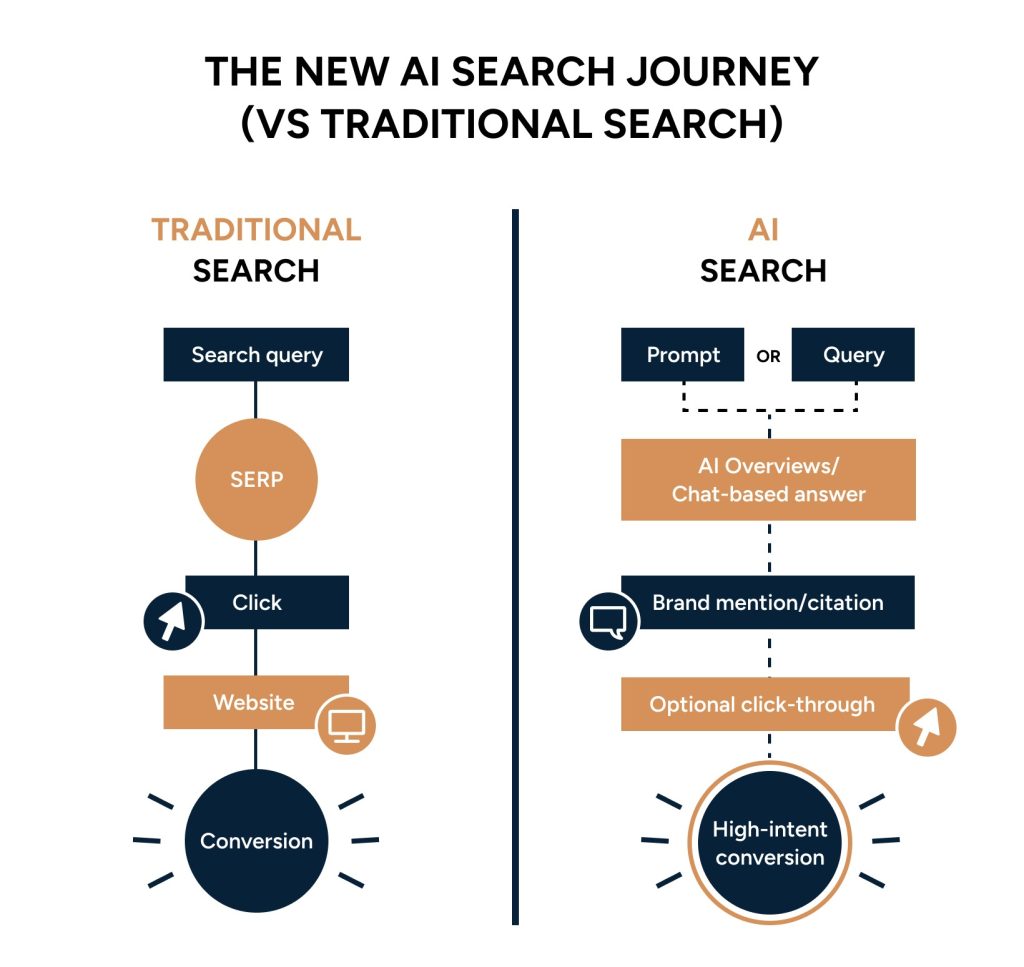
One of the biggest challenges with AI Search is measurement. Classic models assumed a straight line: impression → click → session → conversion. Now, a growing share of exposure happens in environments where users see your brand or your content excerpted inside an AI result, with no click at all.
That doesn’t mean it has no value. It just means we need to think differently. Alongside traditional analytics (engagement from AI-driven traffic, organic trends in Search Console, etc.), brands are starting to look at:
- Brand lift and recall where AI exposure is part of the mix
- Correlations between known AI visibility and uplifts in direct or branded search traffic
- Specialist tools that track AI Overviews, AI snippets and citations over time
At Pod Digital, we also use advanced monitoring technology that simulates AI search behaviour across multiple platforms. It tracks when content is surfaced, cited or summarised by different AI engines, even when no click occurs. This gives us a clearer picture of your “invisible exposure”. These are the moments where an AI system uses your content to answer a query, influence a user or reinforce your authority. We can identify patterns, spot emerging opportunities and measure the real impact of AI-led discovery.
In practice, AI exposure will likely be treated more like impressions from display or video, an influence to be modelled, not a simple last-click touchpoint. The important thing is to keep testing, keep watching the data you do have and keep iterating.
Is Content Still the Heart of Digital Marketing?
If you’re asking why content is important for SEO, the answer is simple: content is the bridge between your brand, your audience and AI search engines.
The brands winning today are those producing:
- Clear
- Helpful
- Updated
- Structured
- Intent-led content
And doing it consistently.
Content marketing hasn’t become less important; it has become essential to every part of digital growth.
2026 isn’t the year to sit back and see what happens. It’s the year to lay the groundwork so that, as AI search matures, your brand is already the one being cited, surfaced and trusted.
Let’s Build Your AI-Ready Content Strategy
Are you ready to make your content visible in AI Search?
If you want your brand cited, surfaced, and trusted by AI engines, not buried beneath them, we can help.
Speak to our team today and let’s build an AI-ready content strategy that drives real results.
FAQs: Making Your Content More AI-Friendly
Do we need to rewrite all our existing content for AI Search?
Start with your highest-value pages. Choose the ones that drive leads, sales or brand visibility. Optimise those first. Improve structure, clarity, schema, internal links and freshness. Then roll those learnings out to the rest of your content over time.
What’s the easiest win today to improve AI readiness?
Add clear, question-based subheadings, answer each question in the first line of that section and check for missing alt text on key images. Then make sure your most important pages have an appropriate schema. These are all realistic, high-impact steps for a content team.
Does optimising for AI replace traditional SEO?
No, optimising for AI extends traditional SEO. Technical hygiene, internal linking, keyword and topic research and strong UX are still essential. AI optimisation simply adds a new layer of structure, semantics, and formatting designed for how modern assistants read and reuse your content.